Schengen Area, which countries it includes and how to calculate 90 days in 180
11 min
If you're planning a trip around Europe and you don't have EU freedom-of-movement rights, there's a rule worth understanding before you buy the flight: you can stay a maximum of 90 days within any 180-day period, when your situation is subject to the Schengen short-stay rule.
The problem is that those 180 days aren't a fixed six-month block, entry and exit days count, and making several trips can turn the calculation into a puzzle.
The good news is that once you understand how it works, it's not that complicated.
What exactly is the Schengen Area?
The Schengen Area is a European zone where internal border controls have been removed between the countries that belong to it.
This lets you, for example, travel from Spain to France or from France to Italy without normally going through a border check like the one you'd find entering from a country outside Schengen.
But there's an important distinction: Schengen is not the same as Europe, and it's not exactly the same as the European Union either.
It currently consists of 29 countries: 25 belonging to the European Union and 4 that don't belong to the EU — Iceland, Liechtenstein, Norway and Switzerland.
Bulgaria and Romania have been fully integrated members since 1 January 2025, after internal land border controls between these countries and the rest of the area were removed.
The list can change, so if you're planning a trip it's always worth checking the current situation on the European Commission's official Schengen Area page.
The 29 Schengen Area countries
From the European Union (25): Austria, Belgium, Bulgaria, Croatia, Czechia, Denmark, Estonia, Finland, France, Germany, Greece, Hungary, Italy, Latvia, Lithuania, Luxembourg, Malta, Netherlands, Poland, Portugal, Romania, Slovakia, Slovenia, Spain and Sweden.
Outside the European Union (4): Iceland, Liechtenstein, Norway and Switzerland.
Schengen, the European Union and Europe are not the same thing
| Concept | What it is | Example |
|---|---|---|
| Europe | Continent | Includes the UK, Switzerland, Serbia… |
| European Union | Political and economic union | Spain, France, Germany… |
| Schengen Area | Common area without internal borders | Spain, France, Switzerland, Norway… |
That's why some situations can seem strange:
- Switzerland and Norway are in Schengen but don't belong to the EU.
- Ireland belongs to the EU but isn't part of the Schengen Area.
- Cyprus belongs to the EU but isn't yet fully part of the Schengen Area.
For trip planning, this difference matters more than it seems.
What does the 90-days-in-180 rule mean?
This is the one that causes the most confusion. For travelers subject to the short-stay regime:
You can stay a maximum of 90 days within any 180-day period.
The key word is "any."
It doesn't mean "90 days from January to June and another 90 from July to December." And it doesn't mean "I leave Europe and automatically get 90 days back."
The reference period moves with the calendar. The right way to understand it is to look 180 days back from each day of your stay and check that the total days spent in Schengen don't exceed 90.
An example
Imagine you enter Schengen on April 1 and stay for 30 days. You've used 30 days.
Then you leave for 20 days and re-enter. You don't start from zero: those previous 30 days still count as long as they're within the 180-day window. When you return you'll have 90 − 30 = 60 days available, as long as there aren't other earlier stays that also need to be counted.
That's the most common mistake: leaving Schengen doesn't reset the counter.
Does the entry day count?
Yes. And so does the exit day.
The European Commission's official short-stay calculator uses precisely the entry and exit dates to calculate the length of each stay.
For example, entering on April 1 and leaving on April 10 is 10 days, not 9. It seems like a small difference, but close to the 90-day limit, a single day can matter.
What if I visit Spain, France and Italy?
Days accumulate within Schengen.
On a trip Argentina → Spain → France → Italy → Germany → Argentina, you don't have 90 days for each country. You have a maximum of 90 days within the Schengen Area, if your situation is subject to the 90/180 rule.
Switching countries within Schengen doesn't reset the counter.
So when do I get my days back?
There's no magic day when the counter jumps from 0 to 90. Used days stop being part of the window progressively as time passes.
If you've used all 90 in one go, you'll normally need to spend enough time outside to have the full 90 available again. But if you've made several separate stays, the calculation gets considerably more complex.
How many Schengen days do you have left?
If you've only taken one long trip, you can probably work it out by hand.
But imagine that in the last six months you've spent 15 days in Spain, 12 in Italy, 8 in France, 20 in Greece and 10 in Germany. Looking at your last trip alone is no longer enough: you need to analyze the dates and determine which days are still within the relevant 180-day window.
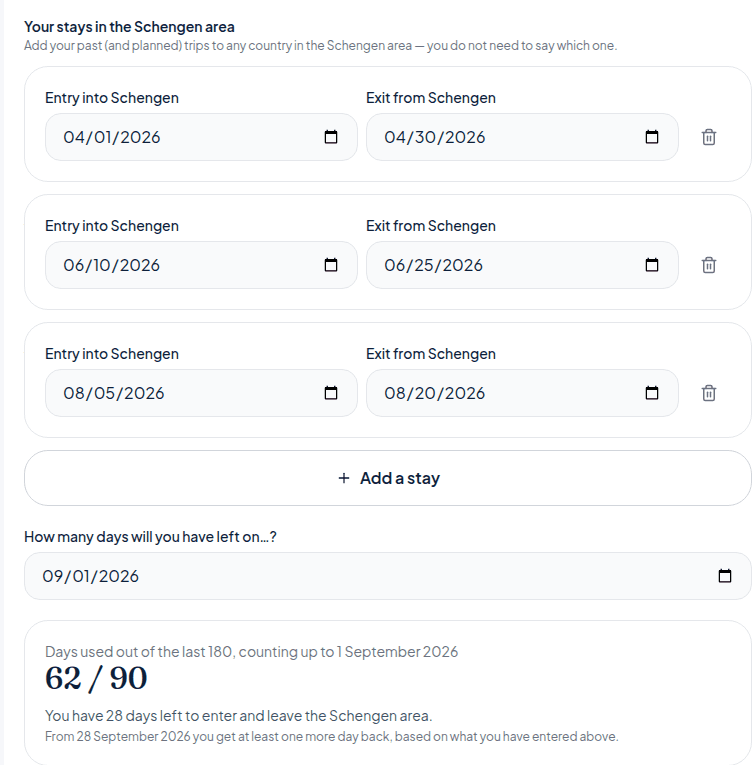
This is where a calculator saves you from mistakes. On the TripPlan Schengen Calculator you add each stay with its entry and exit date, choose the date you want to check — today, or the day you plan to enter — and it tells you how many of your 90 days you've used, how many you have left, and from which date you'll regain margin.
It's free, requires no registration, and the data is saved only on your device.
The European Commission also has its own official calculator, linked above, which applies this same calculation principle.
Who is subject to the 90/180 rule?
This is where it's important not to oversimplify.
The rule applies to certain short stays by third-country nationals, both when they need a visa and when they're exempt from one for short stays.
Nationality alone doesn't tell the whole story. It also matters whether the person holds a residence permit, a long-stay visa, a particular status as a family member of an EU citizen, or a short-stay Schengen visa with specific conditions.
Anyone with an EU residence permit or a long-stay visa shouldn't treat those stays as if they were automatically part of the same 90/180 calculation.
Before using any calculator, check on Your Europe that the 90/180 rule is actually the one that applies to your situation.
Do I need a Schengen visa?
It depends on your nationality and the circumstances of your trip. There are countries whose citizens can enter without a visa for short stays and others whose citizens must apply for one.
But having a visa exemption doesn't mean you can stay indefinitely: travelers subject to the short-stay regime still have to respect the 90/180 rule.
And holding a Schengen visa doesn't automatically mean you can stay 90 days either: the visa itself states the conditions of the authorization, including the permitted length of stay.
It's worth distinguishing between the visa's validity period and the maximum authorized length of stay. A visa being valid for six months doesn't mean you can stay six months within Schengen.
Which European countries are not in Schengen?
Among the most relevant for a traveler:
- Ireland — EU member, outside Schengen.
- Cyprus — EU member, not yet fully integrated into Schengen.
- United Kingdom — outside Schengen and outside the EU.
Also outside the area are Albania, Bosnia and Herzegovina, Montenegro, Serbia, North Macedonia and Kosovo.
Watch out for one idea: being outside Schengen doesn't mean you can enter without immigration requirements. Each country has its own entry conditions.
What about Andorra, Monaco, San Marino and the Vatican?
These small states have particular border relationships with the Schengen countries surrounding them. That's why "I'll go to Andorra for a few days and reset my 90 days" doesn't work.
What matters for the calculation is which days you actually spent within Schengen territory and how your entries and exits occurred. And the entry requirements of these microstates can differ from the rest of Europe.
What happens if I go over the 90 days?
This isn't worth taking risks with.
Exceeding the authorized period can constitute a breach of the immigration rules applicable to your situation. The specific consequences depend on the circumstances and national rules: problems on exit, difficulties with future trips, penalties or other immigration consequences can arise.
There's no single consequence that applies to every case, so it's also not worth trusting the round numbers that circulate online.
If you think you may have overstayed your authorized period, the sensible thing is to check your specific situation and get official or specialized advice.
An important update: EES
If you're reading older information about Schengen, you'll probably find many references to manual passport stamping. That's changing.
The Entry/Exit System (EES) electronically records the entries and exits of certain third-country nationals making short stays at external border crossings.
Why does it matter? Because control of short stays is becoming increasingly digitalized. If you make several trips, keeping your own correct record is still a good idea.
You can check the status and operation of the system on the European Commission's official EES page.
What about ETIAS?
ETIAS is a different thing, and shouldn't be confused with EES.
EES records entries and exits. ETIAS will be an advance travel authorization for certain visa-exempt nationals.
The date it comes into operation should always be checked on the official ETIAS information page, since it can be updated.
Can I work during my 90 days?
You shouldn't interpret the 90/180 rule as a general permit to work in Europe.
The fact that someone can enter for a short stay doesn't mean they're entitled to carry out any work activity. The requirements depend on nationality, country, activity and immigration status.
If you intend to work, reside, or carry out a professional activity that requires authorization, you need to check the specific rules that apply.
Three very common mistakes
"I leave Europe and get 90 days back." No. Leaving Schengen doesn't erase previously used days.
"I have a visa valid for six months, so I can stay six months." Not necessarily. The visa's validity and the authorized days of stay are different concepts.
"I have 90 days for each country." Also not true. Spain, France, Italy, Germany and the rest are part of the same Schengen Area for the purposes of this calculation.
Why adding up the year's trips doesn't work
Imagine someone subject to the rule takes these trips:
| Trip | Days in Schengen |
|---|---|
| January | 20 |
| March | 15 |
| May | 25 |
| July | 10 |
At first glance you might think: 20 + 15 + 25 + 10 = 70 days.
But the real calculation isn't about adding up all the year's trips. You need to look at which specific days fall within the moving 180-day window corresponding to the date you're checking.
That's why the right question isn't "how many days have I spent in Europe this year?" but "how many days have I spent in Schengen within the 180 days before the date I'm checking?"
That's exactly the calculation the calculator does.
Frequently asked questions
How many days can I stay in Schengen? For short stays subject to this rule, the general maximum is 90 days within any 180-day period.
Does the day I enter count? Yes. And so does the day I leave.
Does leaving Schengen reset the 90 days? No. Leaving doesn't automatically erase previously used days.
Can I spend 90 days in Spain and another 90 in France? No, if both stays are subject to the same 90/180 regime. Both countries belong to the same Schengen Area.
Are Bulgaria and Romania part of Schengen? Yes. They've been fully integrated members since 1 January 2025.
Is Switzerland part of Schengen? Yes. Switzerland doesn't belong to the EU, but it does belong to the Schengen Area.
Is Ireland part of Schengen? No. It maintains its own border and visa regime.
Is Cyprus part of Schengen? It's not yet fully integrated.
When do I get my 90 days back? There's no automatic reset when you leave. Days progressively stop being part of the moving 180-day window as time passes.
Does the 90/180 rule apply to everyone? No. It depends on each person's immigration situation. Those with residence permits or long-stay visas aren't subject to this rule in the same way.
Before packing your bags
The Schengen rule looks complicated, but the idea is simple: 90 days within any moving 180-day period. What complicates it is the calendar, once you start combining several trips, entries and exits.
If you're planning a trip and want to know whether your dates fit, the sensible move is to check your situation first with the Schengen Calculator.
And if the numbers add up, the next step is deciding how to make the most of those days: with the TripPlan planner you can organize destinations, dates, itinerary, budget and transfers around the time you actually have available.
This guide is informational and based on official sources consulted in September 2026. Entry and stay conditions depend on nationality, visa type, residence permit and personal circumstances. If your situation is particular, or you think you may have overstayed your authorized period, consult the relevant official information or seek professional advice.